The pace of innovation in the IT sector shows no signs of slowing down, and the new year will bring dramatic changes that will significantly shake up the market. Since the old formulas for success no longer apply, we’ve summarised the groundbreaking trends and expert advice to help you stay prepared.
How quickly and effectively can we adapt to changes in the IT sector? According to Gartner, that’s the question leaders should be asking themselves, as innovation is no longer a matter of choice.
Gartner states that numerous changes are necessary to build resilient foundations, coordinate intelligent systems, and preserve corporate value. Moreover, the pace and interconnectivity of these trends indicate that no investment operates in isolation—architectures, data, management, and business models must advance together.
Trends That Will Transform the IT Sector
At TITANS, we’ve summarised 25 innovations that will determine which companies succeed in the market and which will be at risk.
1. The Physical Form of AI
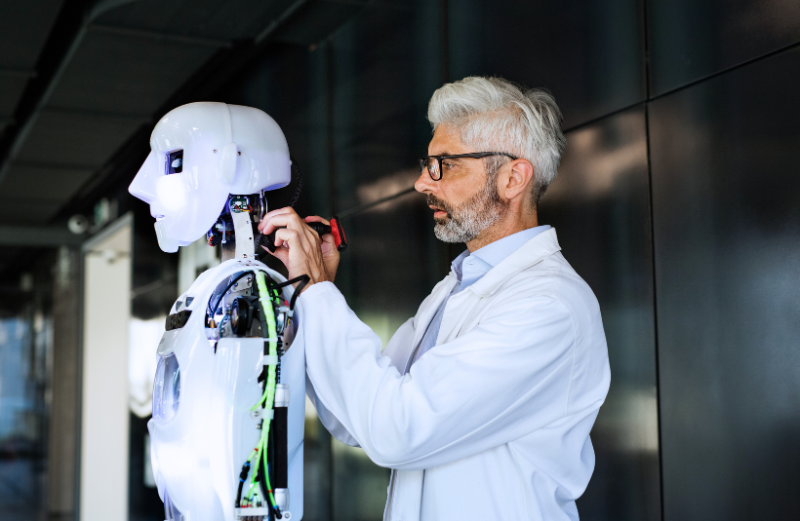
Intelligent systems are no longer limited to screens—they are embodied, autonomous, and capable of solving real-world problems in the physical world.
2. The Failure of Agentic Projects
Gartner predicts that 40% of agentic projects will fail by 2027. However, the reason is not that the technology doesn’t work, but rather that organisations are automating broken processes instead of redesigning them.
3. Hardware Efficiency
Alongside massive models with billions of parameters, efficient models will emerge that take hardware into account and run on modest accelerators.
4. Multimodal AI
Generative models must be multisensory so they can perceive the world like humans and even detect signals that we might miss. Nevertheless, these models cannot function without human oversight.
5. AI-Native Technology Companies
Leaders are shifting from traditional IT management to coordinating teams made up of both humans and agents. In the process, CIOs are becoming AI ambassadors.
6. Confidential Computing
Confidential computing keeps data encrypted even while it is being processed. This enables the secure use of AI and analytics on untrusted infrastructure.
7. AI as a Team Member
In the realm of AI, we will see a shift from individual use to coordinating workflows, linking data across departments, and executing projects from concept to completion. Another key trend is that AI will evolve from a passive assistant to an active collaborator that meaningfully solves problems and makes decisions. Furthermore, intelligent agents will no longer be designed and deployed solely by developers, but also by ordinary business users.
8. Multi-agent systems
These are groups of agents that interact with one another to carry out complex work processes.
9. Cross-functional and Cross-channel Superagents
These agents will operate in various environments—in a browser, editor, or inbox—without requiring users to manage dozens of separate tools. We can also expect interfaces and applications that adapt to any scenario, turning every user into an AI creator.
10. Quantum Computers
According to IBM, in 2026 a quantum computer will, for the first time, outperform a classical computer at solving problems.
11. Decentralised AI
Decentralised networks of agents will emerge—agents capable of learning from one another, sharing information, and retaining important knowledge over the long term.
12. Weaponised AI
Strategic partnerships are essential in the crisis caused by deepfakes and weaponised AI—not only to strengthen defences, but also to anticipate the next wave of sophisticated models and industry-specific vulnerabilities. There is also discussion of a shift toward a layered security model.
13. Open-Source AI
This year, the open-source AI sector is expected to see global diversification of models, led by Chinese multilingual and enhanced reasoning versions. Other trends will include interoperability as a key competitive factor, as frameworks and runtimes align around common standards. Lastly, enhanced governance with security-audited versions and transparent data pipelines is highlighted.
14. Supercomputer AI Platforms
Supercomputer AI platforms are driving groundbreaking innovations in model training and analysis. However, they require careful management and cost control.
15. Reevaluating Identity and Access Management Strategies in Enterprises
In the coming years, the number of AI agents and other non-human entities in enterprises will significantly exceed the number of human users. Discovering, monitoring, and protecting every person and every AI agent is becoming essential to responsible and secure AI deployment.
16. AI Security Platforms
Gartner emphasises the need for AI security platforms, frameworks, monitoring, and governance that specifically manage AI models, pipelines, APIs, and related components.
17. Domain-Specific Language Models
Domain-specific language models will be smaller, multimodal models designed to provide higher accuracy and compliance for specific use cases across various industries.
18. Preemptive Cybersecurity
Organisations must protect AI across four areas: data, models, applications, and infrastructure. They will also be able to use AI to defend against threats that move at machine speed. A shift toward preventive cybersecurity will be crucial, leveraging AI to anticipate and block threats before they reach companies.
19. Digital provenance
This involves tracking the source, history, and authenticity of data, software, machine learning models, and AI-generated content.
20. AI-Native Development Platforms
These platforms integrate generative AI capabilities directly into the software development lifecycle. They will enable small teams to quickly and flexibly create software using generative AI.
21. Geopatriation
Workloads and infrastructure will be migrated to regional or sovereign clouds, allowing companies to avoid geopolitical, regulatory, or supply chain risks. This will require a reevaluation of architectural decisions.
22. Agentic Parsing
Instead of a single system interpreting an entire dataset, synthetic parsing pipelines will break documents down into individual parts and route each one to the model that best understands it. Furthermore, AI agents will continuously scan the corpus, create deep semantic profiles, and index everything in a multidimensional graph. These trends are leading toward self-aware corporate data systems that will serve as the foundation for faster decision-making and smarter workflows.
23. Strategic Hybrid
Organisations will transition from a cloud-first approach to a strategic hybrid model: the cloud for elasticity, on-premises for consistency, and the edge for immediacy.
24. Systems, Not Models, Will Define Leadership in AI
Coordination—the combination of models, tools, and workflows—will be key. We will also see a more collaborative approach to models. Smaller models will be capable of performing many tasks and, when necessary, delegating tasks to a larger model.
25. AI Resilience
For organisations to achieve this, they need to ensure AI sovereignty—that is, the ability to continuously monitor and control their AI systems, data, and infrastructure. Transparency and trust will also remain priorities, so agents must be designed to explain how they arrive at their outputs. This means building sovereignty through modularity—designing AI environments so that workloads, data, and agents can be moved between trusted regions and providers.
Conclusion
A company’s success will not depend solely on having the most sophisticated technology. The organisations that thrive will be those that have the courage to overhaul their processes, rigorously align every investment with business outcomes, and seize opportunities before they pass—rather than simply relying on automation.
CIOs and technology leaders who thoroughly prepare for these trends, align their architecture with business goals, and embrace change will do more than keep up—they will lead the market.
If you lack expertise in AI, you can find all the information you need about hiring IT specialists here.